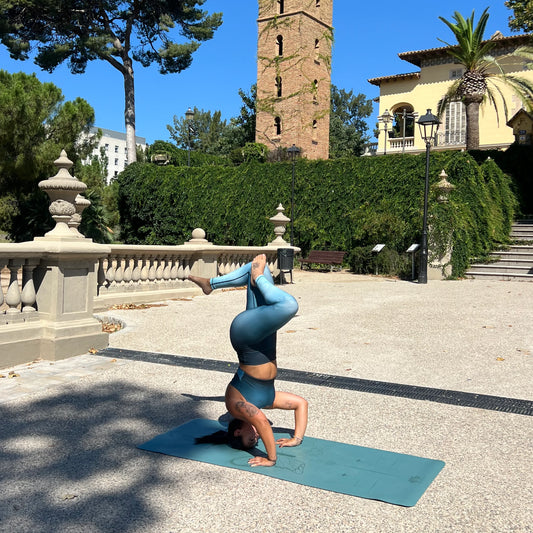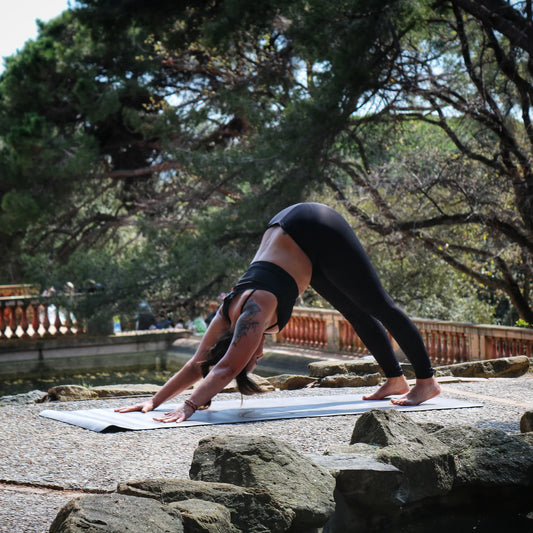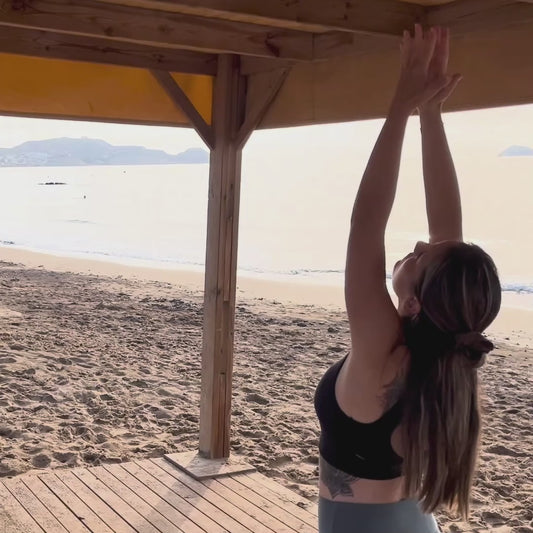
As yoga began to spread more widely, many of its representations were modified. Some were simplified and reduced, obscuring the profound richness that yoga possesses.
Let's begin...
Hatha Yoga (Ha: sun, Tha: moon) is the first type of physical yoga to present a list of asanas (yoga postures) from the 10th century onwards, as a way to help practitioners of Raja Yoga ( the yoga of Patanjali).
In other words, we could talk about the same technique that Patanjali refers to, only perfected around working with the body.
The word yoga (Sanskrit for "union")can refer both to the means of achieving union and to union itself. Similarly, we can say that yoga is the practice of silencing the mind, or that yoga is the state in which the mind is silent.

But what are asanas?
"Two forces that, when balanced, result in balanced and harmonious actions."
The word asana comes from the Sanskrit word for "meditative seat."It represents an exercise in which one experiences a process of regulation and harmonization between opposing forces under the watchful eye of the "observer."
We realize that asana is not merely a physical exercise, but a true tool for holistic work. There are as many asanas as there are ways to position our body with awareness and alignment.
In other words: what makes a body posture an asana is the essence of what it represents.
👉 Click on the image and discover our Dara "Duality of Life" design mat 🥰

Key aspects in performing an asana:
For a posture to become an asana, it must meet certain conditions:
- ATTENTION: "Focusing your attention on a single point and place allows you to fully experience the here and now."To pay attention is to voluntarily direct your awareness toward something, so that little by little it transforms into consciousness (the achieved perception of that something). To what? To whatever arises in your practice: the spontaneous dance of the mind, a part of the body in action, the breath, or the complete integration of the posture.
- RELAXATION: "Enjoyment is also a face of the profound."Here a transcendental element emerges: the harmonious balance between tension and relaxation, and the perfection a posture acquires when the effort to perform it becomes effortless. (Depending on the asana, the degree of sedation or activation will vary.)
- BREATHING: "It is impossible to separate breathing from the practice of asanas." Breathing opens the door to subtle aspects of yoga practice:deeper levels of awareness, greater relaxation, refinement of alignment and positioning, among others.
- ALIGNMENT: "Exercising our kinesthetic senses enhances our proprioception and our practice."It consists of the subtle and precise regulation of the positioning of each area of the body. It is adynamic and constant process .
- INTEGRATION: "Then, the pairs of opposites cease to torment."The integration of the four previous aspects represents, at the same time, the integration of all aspects of the human being. It is the manifestation of holistic harmony: posture harmonizes muscle tension and breathing, while consciousness becomes both cause and effect of what happens in the body.
In accordance with this, work has no other purpose than to illuminate our lives, project consciousness, and harmonize our daily reality.
If you're interested in this, you can read more on our blog about incorporating yoga as a lifestyle. ✨

Benefits of Yoga postures:
Yoga is presented at different levels of depth, and at each level the benefits are different and valuable. Each posture is personal, enriching, and suited to the individual practicing it.
Asanas offer a method of self-knowledge, therapy and harmonization, in addition to improving body posture, organic functions and many other aspects.
Although its essential goal is to silence the mind to discover our essence, all other benefits are worthwhile to the extent that they help us achieve that purpose.
You can also read about the benefits of yoga for the body and mind ✨
Namaste! 🧘